пятница, 1 декабря 2017 г.

Women's Summer Muscle-Building Plan!

Women's Summer Muscle-Building Plan!

Want to turn heads this summer? Cover model and highly sought fitness coach Jen Jewell has you covered with her game plan for building a show-stopping physique! Rather than focusing on dropping weight—a common trend among the bikini-clad crowd—she suggest you focus on building muscle to achieve your dream physique.


Muscle adds attractive curves to all the right places, giving you the fit look you desire. The increased muscle mass also revs up your metabolic rate, helping to burn any excess fat you may have in the process. The end result? A complete summer makeover!


Get to work on your desired beach body with Jewell's top muscle-building tips and workouts!


1


While you might think the first change you should make has to do with pumping iron in the gym, that's not the case. When it comes to putting on lean mass, nutrition is everything.


"Embrace carbs and protein!" Jen explains. "More often than not, I hear about women skimping on carbs because they think adding too many of them will cause a sudden surge in body fat." It's time to bust that myth. Sure, overdoing anything isn't good, but carbs in moderation are OK—heck, they're even essential.


A big believer in simple, sustainable steps, Jen recommends you focus on including sufficient carbs and protein in your post-workout meal, since it aids recovery and muscle building the most.


A photo posted by Jen Jewell (@fitnessjewell) on Apr 10, 2015 at 9:22pm PDT


Carbs are important for performance, and protein is important for muscle growth. And no, supplementing with shakes won't make you bulky. So, how much should you aim for?


"As far as protein goes, I go for 1-1.5 grams of protein per pound of body weight each day," Jen says. Aim for roughly 25 grams of protein after your workout, and spread the balance across your other meals.


Your overall carbohydrate and dietary fat intake will vary based on your total energy needs, exercise intensity, and exercise duration, but it's safe to aim for 30-50 grams of carbohydrates after your workouts to replenish your energy and jump-start recovery.


What's the best thing to eat before a sweat session? For your pre-workout meal, Jen recommends sticking with foods that are low in fat and contain easily digestible carbs—meaning carbs low in fiber. They'll provide a fast source of energy for the session at hand.


Jen also opts for a high-glycemic carb post-workout to help quickly replenish muscle glycogen (stored energy) levels. Some options include rice, bread, potatoes, and fruit. Have a sweet tooth? Fat-free candy like pixie sticks and gummy bears are another great option! Pair your carbs with a fast-digesting protein like Cellucor COR-Performance Whey for optimal results.


2


"In order to build muscle, you're going to have to challenge your body and stimulate your muscle fibers in a new way," Jen says. "Kick those light weights to the curb, and get ready to really work it!"


Too many women coast through their workout routines and do the same thing over and over again, which leads to a lack of results. "In order to get results, you need to have a clear-cut plan of action each time you hit the gym," says Jen. "This means changing your weight, rep scheme, or exercises in order to keep stimulating the body."
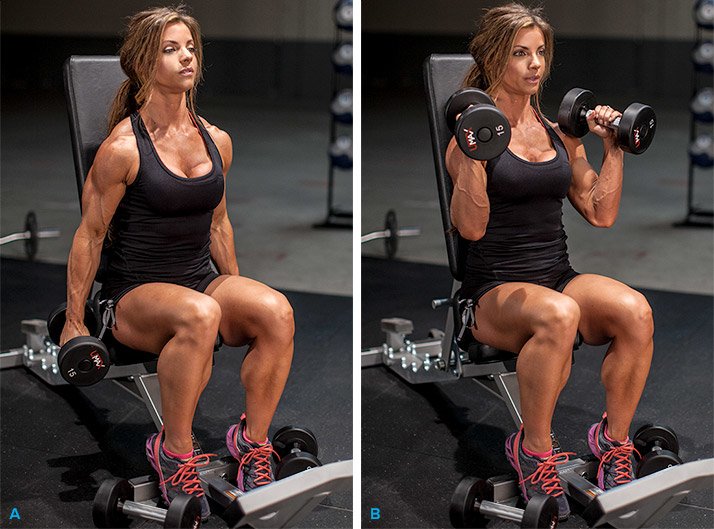

"In order to get results, you need to have a clear-cut plan of action each time you hit the gym," says Jen.

One of Jen's favorite muscle-building techniques is the dropset, a technique where you choose a weight, do reps to failure, and then immediately continue with a lighter weight. You can drop multiple times for an increased effect. "Dropsets are my favorite way to build muscle or help bring up a lagging muscle group or body part," Jen adds.


As Jen explains, dropsets work so well because, in a given set, you are only recruiting a certain percentage of the muscle fibers. But when you do one full set at a higher weight, strip the weight down, and immediately pick up a lighter weight, you recruit untapped fibers. This creates more stimulus and encourages new growth. It also burns a lot of calories!


"Whatever rep range I'm using, I always focus on pushing my reps to failure," Jen emphasizes.


3


Going hard in the gym seven days a week doesn't lead to exponential gains. To build maximum muscle, you must take rest seriously. You actually tear your muscles down while in the gym. In order for them to properly recover and build, they need to have weekly rest time.


A photo posted by Jen Jewell (@fitnessjewell) on Feb 3, 2015 at 6:20pm PST


"I always take at least one day of full rest from my workouts each week," Jen says. "This means no weights or cardio. Sometimes it'll be an active rest day and I'll do a yoga class, but I definitely make sure to allow my body enough time to recover from lifting."


Recovery can also be aided by what you eat. "Proper supplementation and nutrition are key as well," Jen says. "During or at the end of every workout, I take Cellucor Alpha Amino. The amino acids in this product help not only with recovery, but growth as well."


4


You may have a picturesque physique in mind, but your overall health is always important. "In an effort to achieve optimal health, cardio should be done year round," Jen says. "Including cardio as a key component to your workouts is essential in order to stay at a healthy, lean level while adding muscle."


All too often, Jen says she sees people make the mistake of cutting cardio out completely during a muscle-building cycle. Ultimately, she says, this means putting on too much fat mass and then having to "cut" that off. Over time, this cycle can lead to a repetitive loss of hard-earned muscle and very small net gains.


"Bulking/cutting is a vicious cycle that I see many competitors go through, and it's not the best way to make overall improvements to your physique," Jen states. "If you can maintain a healthy level of body fat the entire year, adding muscle—and being able to hold on to your muscle—is definitely doable."


Jewell recommends that you opt for high-intensity interval training (HIIT) rather than steady-state cardio training. HIIT workouts are based on alternating intervals of all-out work and slower, recovery work. For example, you can sprint on the treadmill or outdoors for 15-20 seconds, walk for 40-45 seconds, and then repeat.


"Adding these more intense bouts of exercise combined with brief stints of recovery can help aid fat loss while helping preserve hard-earned muscle," Jen says. For optimal benefits, she recommends 3-4 sessions of 20 minute each per week.


5


Nearly everyone struggles with lagging motivation occasionally. As the summer weather starts to heat up, it's not abnormal at all to find yourself wanting to forgo the gym to soak in some sun.


Jen has an easy solution for this: "Skip the gym!" Staying out of the gym doesn't mean skipping out on your workout; it just means embracing the outdoors. "I take my workouts outdoors whenever I can," Jen says. "I'm all about having fun with fitness."


"Don't be afraid to take a day off from the weights and head out into the local park, track, or beach to mix up your usual routine," she adds.


Staying out of the gym doesn't mean skipping out on your workout; it just means embracing the outdoors.

While you might not be able to do quite everything outside that you'd do in a brick-and-mortar gym, you can certainly do a lot to keep your muscles stimulated. Bodyweight exercises, sprints, or resistance-band work in the park will all transform your body and keep your muscles stimulated sans weight-room equipment.


As with all fitness endeavors, variation is key with outdoor workouts in order to prevent a progress plateau. "Aside from bodyweight exercises, try doing cardio by running the stairs or sprinting on the track, or grab some friends for a game of volleyball or softball," Jen suggests.


Now that you know Jewell's top tips for muscle-building success, it's time to dive into her workout. With this workout, you'll have two days off per week. Add them into the program wherever they fit best with your schedule—preferably one midweek and another on the weekend.


Note: the dropsets should only be implemented occassionally—not every workout. When you don't do a dropset, perform a regular set.
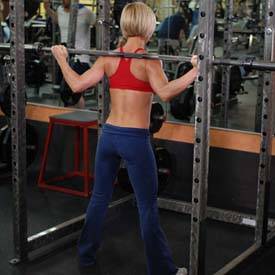
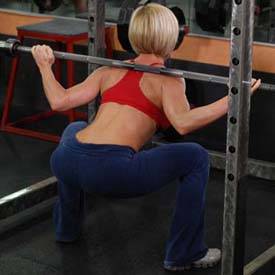
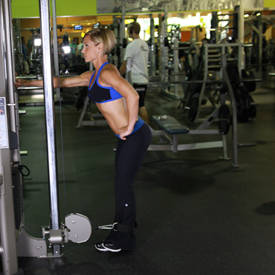
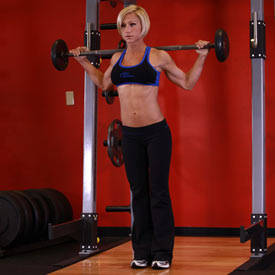
Wide Stance Barbell Squat
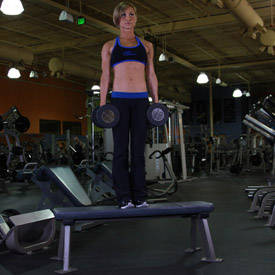
Single-leg deadlift

Wide Stance Barbell Squat

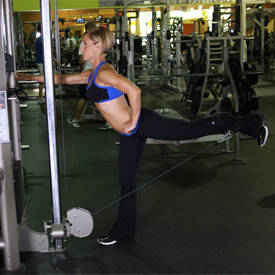
Glute cable kick-back
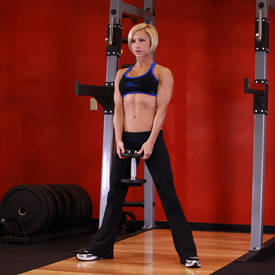
Plie squat

Glute cable kick-back

Plie squat

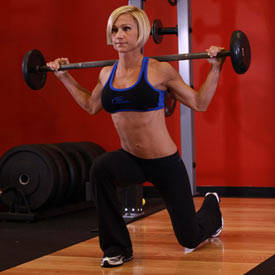
Reverse barbell lunge
Step-up to kick-back

Reverse barbell lunge

Step-up to kick-back
Exercise note: Perform a step-up as you normally would, then perform a kick-back with the other leg. Squeeze your glute.

Walking lunge with kick-back in between lunge
Exercise note: Kick your back leg up and squeeze your working glute.

Side lunge

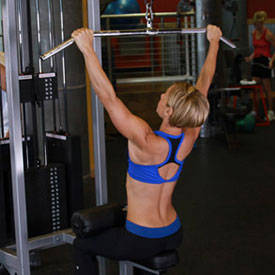
Wide-Grip Lat Pulldown
Overhead triceps rope extension

Original article and pictures take www.bodybuilding.com site

среда, 29 ноября 2017 г.

Wide-Grip Lat Pulldown (Fitness Tip Tuesday)

Wide-Grip Lat Pulldown (Fitness Tip Tuesday)
back-exercises-for-women

Wide-Grip Lat Pulldown


How To: Kneel with legs shoulder-width apart. Pull your shoulders down and back. Keep your chest up and core tight. Your torso should remain in nearly the same position from start to finish.


Muscles Used: Lats, Biceps, Shoulders, Mid Back.


Original article and pictures take www.flaviliciousfitness.com site

понедельник, 27 ноября 2017 г.

Why You Aren't Gaining Muscle (and What to Do About It)

Why You Aren't Gaining Muscle (and What to Do About It)
Shutterstock

That fitness expert on Instagram with glutes that seem to defy gravity can make you wonder, "How does she do that?!" It's true, everyone's body is built differently and doesn't put on muscle the same way. By learning more about your muscles, you'll discover the best way to get that lifted booty.


1. Muscle Can Maintain Your Weight


Functionally, muscles protect your bones, organs, and tissues—and even help you heal quickly. Kathryn Sansone, a certified fitness trainer and the founder of GreekGirl Beauty Protein, adds that muscles can also be important to maintain your weight. "Muscle requires more energy and therefore burns more calories than fat," she says. "The more muscle mass you have, the faster your metabolism is." More muscle means burning more at rest, plus being able to work harder during your workouts. Double-win.


2. It Can Also Cause Gains, So Don't Panic


Women might worry when they see the number on the scale go up. "A pound is a pound no matter what, but the volume of one pound of muscle is much smaller than one pound of fat," says Jacklyn Sklaver, NASM personal trainer and CISSN sports nutritionist. Instead, measure your waist, your hips, and your body fat percentage to keep track of your physical progress.


3. Strength-Train for Optimal Results


Sklaver recommends women strength-train four times a week to see results. "Some women can stick to only weight training with no cardio," she explains. "Others may need to do cardio 30 minutes a day three to five times a week for the best results." Sklaver adds that it's also beneficial to add compound movements (total-body exercises) to burn more calories. "Full-body workouts are ideal for maximum muscle growth," she says. "The more a body part is used, the more hypertrophy that occurs." Focus on working the largest muscle groups in the body: the glutes, quads, and hamstrings. Training the upper body in conjunction helps create an hourglass shape. You can cut back on that treadmill time, too—Sklaver says too much cardio can lead to difficulty gaining muscle.


4. "Bulking Up" Is Rarely a Thing


Don't be afraid that you'll come out of the weight room looking like John Cena. "Women who are 'bulky' are following a nutritional plan, have been working out for many many years, and may have goals of increasing strength rather than body composition," says Sklaver. It takes A LOT more effort to gain muscle than to gain or lose fat. Meaning if you lift weights, you won't become huge right away. If you are prone to bulking up, Sklaver advises focusing on your nutrition. "Find a daily caloric and macronutrient intake, meal prep, and eat for performance and recovery."


5. Men Build It More Easily Than Women


Our male counterparts produce more testosterone—the hormone responsible for growth, and are also genetically built to have bigger muscle fibers, which helps them gain more mass. Women produce more estrogen, which means our bodies naturally carry more body fat than lean muscle. Body type and genetics can also play a role in that body composition, but fortunately so can nutrition.


6. Your Diet Plays a Major Part


"Muscle requires the right amount of nutrients to grow. That includes protein, carbs, and fat," says Lisa Avellino, director of fitness at NY Health & Wellness. She suggests keeping a training and food diary to minimize guesswork and measure your results. Sklaver agrees with Avellino and adds that starving yourself and not eating enough protein can keep you from seeing results. "Muscles are made of protein, so they need protein to grow," Sklaver says. "Complete proteins are any lean animal source, dairy, eggs, fish, and some protein powders." For vegetarians, opt for quinoa, buckwheat, or soybeans, or combine nuts with whole grains to make a complete protein. Many plant-based foods are incomplete proteins, making it harder for the body to absorb enough nutrients. "A good rule of thumb is that you have to eat 30 percent more of an incomplete protein to equal the same benefit of a complete protein source," she explains.


7. Check for Underlying Health Conditions


Sometimes your inability to put on muscle could have to do with health conditions you may not be aware of. Sklaver says it's important to find out if you have any conditions that may affect your metabolism, endocrine system, or thyroid. You should also make sure you're getting enough sleep to cut your recovery time. According to Avellino, our human growth hormone (HGH) levels are highest when we are asleep. "Many studies suggest an association between a lack of sleep and high cortisol levels," she explains. "Cortisol is a catabolic hormone that is linked with stress and can break down muscle tissue." Building muscle and reducing stress go hand in hand.


Original article and pictures take www.fitnessmagazine.com site

четверг, 23 ноября 2017 г.

WHY PERFORMING EXCESSIVE CARDIO

WHY PERFORMING EXCESSIVE CARDIO


It may seem counterintuitive.

After all, if the ultimate goal of losing fat is to maintain a calorie deficit over time by consistently burning more calories than you consume, how could a calorie-burning tool such as cardio end up working against you?

Well, just take a look around your gym for firsthand evidence.
It’s all too common to see those same guys and girls who show up day after day… month after month… even year after year… and still don’t appear to have made any real progress.

In many cases, despite sweating on that treadmill, stairstepper or elliptical for literally hundreds of hours combined (in combination with plenty of time in the weightroom), they actually appear to have gained even more body fat than they started out with.

How is this possible? How is it possible that someone could put so much effort into their training program and actually end up travelling farther away from their goals rather than closer to them?

Simple: although the act of performing cardio does burn calories in the short term, it also stimulates your appetite as well.

When you combine this with the fact that the majority of people aiming to lose fat do NOT track their daily calorie intake with any real accuracy (they simply wing their diet and “eat healthy” throughout the day), and you end up with a real potential problem.

For example, let’s say you performed an hour of cardio 5 days a week, burning 400 calories per session and 2000 calories per week.

That’s all fine and good, but what happens if the appetite-stimulating effect of those same 5 sessions caused you to unknowingly consume, for example, an extra 350 calories per day?

By the end of the week, you’d have burned 2000 calories from your cardio sessions, but would have also consumed an additional 2450 calories, for a net gain of 450 calories per week.

Trust me, this can happen much more easily than you think. Small dietary choices that you make throughout the day add up very quickly, and 350 calories really isn’t much.

A handful of nuts here… a piece of fruit there… small late-night snack…

If you’re constantly feeling hungry and you aren’t keeping track of your daily calorie intake, there’s an almost certain chance you’ll over-eat.

Cardio is not the only culprit here either; weight training or any other form of exercise will also have appetite-stimulating effects as well.

And the simple reality is this: it absolutely does not matter how “healthy” your diet is or whether you’re eating nothing but plain chicken breast, oatmeal and broccoli all day long… if the total number of calories you consume is equal to or greater than the total number of calories that you burn, you are NOT going to lose an ounce of fat, period.

This is known as “the law of energy balance”, and there’s no way around it. In order to lose fat, you must maintain a calorie deficit over time by burning more calories than you consume. Plain and simple.

The key is in finding a proper balance between your training program and your diet that allows you to remain in a calorie deficit throughout the week without causing you to feel excessively hungry.

So, here are 3 immediate steps you can follow right away to help you in this process…

First off, stop over-emphasizing cardio and treating it as the be-all-end-all of fat loss.

Cardio is simply one tool in your arsenal to help you burn additional calories, and most people way over-value it.

As long as your diet is properly structured, 3-4 cardio sessions per week is easily going to be enough for the vast majority of trainees, and some will do just fine with even less than this.

Secondly, include some high intensity interval-based cardio as part of your overall plan.

High intensity interval training sessions (or “H.I.I.T” for short) in the range of 8-20 minutes do not stimulate your appetite to the same degree that traditional slow pace cardio does (in some cases it may even blunt your appetite), and while burning more total calories at the same time. However, because this type of cardio is more stressful to your body as a whole, you can only perform so much before you start getting burned out.

Aim to perform a balanced mix between these two types of cardio throughout the week. For example, 1-2 aerobic sessions lasting 45-60 minutes and 1-2 H.I.I.T sessions would be a good approach.

Third, start tracking your total calorie intake in more detail.

This is by far the most important step of all.

If you’re just eating “on the fly” throughout the day and don’t have a reasonable idea of how many calories you’re consuming in total, your overall progress will definitely be compromised or even eliminated altogether.

Once you have these 3 steps in place, you can simply test and tweak from there to see what works best for you in terms of maintaining your calorie deficit while managing your overall hunger levels.

Some people prefer to create a larger calorie deficit through their diet by reducing their overall food intake and scaling back on the cardio, while others prefer to consume more food throughout the day and burn more of their calories using exercise.

If you found this information helpful, here's what to do next...


Original article and pictures take megapublicadorfunciona.com site

What My Workouts Have Been Looking Like

What My Workouts Have Been Looking Like

I’ve got 5 incredible at home circuit workouts to share with you today! Just grab some dumbbells and you’re ready to GO get it done!


I feel workouts is absolutely one area of my blog that has reeeeeally changed over the past few years.


Back in the day, I used to post about my workouts almost daily. It was just a major part of my life, and my blog, so that’s just what turned out to be my “norm.” Fast-forward to now and yes, my workouts are definitely still an important part of my life, but it’s just not something I wind up talking about all that often.


Be sure to check out my updated workout page with ALL of my favorite circuit workouts, treadmill workouts, and more!!


Do you guys even want to know what I’m doing these days? Or is that totally not interesting? I know there are plenty of other awesome blogs out there doing the workout thang!


Well, regardless, I thought I’d still go ahead today and share some of the workouts I’ve been trying out lately. Like I mentioned before, since we’ve moved in with our friends, it’s been awesome to be able to have a mini gym at my disposal. It has given me the opportunity to shake up my routine a bit more, and is allowing me to work some different muscles in different ways than I’ve been used to.


5 Incredible At Home Circuit Workouts

The first thing I did was hop on Pinterest (you following?!) and started searching for full body circuit workouts with dumbbells. I found a TON, but here are a few that really caught my eye and looked good enough for me to pin and try out.


This full body circuit workout with weights (<—with instructions on how to do each move!) was awesome. I first did it maybe a week or so ago, and I’m thinking I may wind up doing it again tomorrow.


Grab a set of weights and get ready to work your butt, back, legs, core — and just about every other part of your body!

This full body bikini shape-up circuit with weights was a fun one! I did two sets of each of the three circuits (due to time more than anything else) and I definitely felt like it worked the whole body by the time all was said and done.


Bikini Shape-Up Circuit With Weights

This circuit workout with weights (<—instructions on how to do each exercise there!) was a pretty good one. Some of the moves aren’t my favorites, but overall, it was still a solid workout and one I’d likely do again.


Workout with weights to help strengthen your core

This full body dumbbell circuit was another good one I just did yesterday morning. I only had enough time to do two sets of each circuit instead of three, but I was still feelin’ the burn!


This short Bum bell routine is a great home workout! Burn fat build muscle, use weight amount according to your ability. Put some music on and have some fun doing it!

I love Presley. And I also love her dumbbell combo circuit. Compound moves are one of my favorites…work more muscles at once, get a better burn!


dumbbell circuit workout

I’ve also been checking out some of my older circuit workouts, including:


I’ve still been incorporating some of the various Beachbody workouts that I have a day or two a week (mostly PiYo and T25 Gamma lately), so having the full variety has been awesome. It’s making me think that I’m really going to need to find some new equipment so we can create our own home gym soon!


So I’m curious…


  • How many of you workout at home?
  • How many of you are gym-goers?
  • What is your FAVORITE workout right now?

Enter your email address below and subscribe to my weekly newsletter, so you will receive every new workout, delicious recipe and other posts delivered to your email inbox for free. It's a great way to fulfill all of your Sweet Tooth cravings!


Original article and pictures take www.sweettoothsweetlife.com site

вторник, 21 ноября 2017 г.

What a Muscle Building Meal Really Looks Like

What a Muscle Building Meal Really Looks Like
Diary of a Fit Mommy


When it comes to eating your way to a more muscular physique, many people know that it is certainly important to eat enough calories.


However, where your calories come from certainly does matter. Just like with weightloss, muscle building or gaining mass is the same general idea: you must pick the right combo of foods that will accomodate your goals and bodily changes.


doafmAD

Here is a sample of a day's worth of muscle building meals for the average female. (Keep in mind that this is super general)


Meal #1:


  • 5 egg whites (86 calories)
  • 1 oz. turkey bacon (66 calories)
  • 1/2 cup oats (100 calories)
  • 1 cup almond milk (60 calories)
  • 1 cup strawberries (50 calories)

Calorie total: 362 calories


Meal #2:


  • 2 scoops protein powder (The calories per scoop will vary with the brand of your protein. Personally, I love the Veggie Elite protein powder from MRM. It has 130 calories per scoop. Also, you can use code SIA for 40% off at checkout!)
  • 1 cup almond milk (60 calories)

Calorie total: 320 calories


Meal #3:


  • 1 grilled chicken breast, skinless and boneless (145 calories)
  • 1 cup broccoli (55 calories)
  • 1 large sweet potato (159 calories)

Calorie total: 359 calories


Meal #4:


  • 2 tbsp almond butter (203 calories)
  • 1 medium banana (105 calories)

Calorie total: 308 calories


Meal #5:


  • 1 medium salmon steak (243 calories)
  • 1 cup asparagus (40 calories)
  • 1/2 cup quinoa (111 calories)

Calorie total: 394 calories


Meal #6:


  • 5 oz. cottage cheese (128 calories)
  • 1/2 cup fresh blueberries (42 calories)

Calorie total: 170 calories


Complete daily calorie total: 1,913 calories


**This can be adjusted to meet your daily caloric needs. In order to calculate what your daily caloric needs are, you can use this calculator here. All you have to do is put in your age, height, gender, current weight, and activity level. While this calculator is great for a ballpark estimate, the best way to find your daily caloric needs is by visiting a dietician.**


ddd1


Original article and pictures take fitmommydiaries.blogspot.com site

пятница, 17 ноября 2017 г.

Weightlifting Workouts - Back

Weightlifting Workouts - Back
My back after many heavy back workouts

In this hub I am going to described a high intensity weights workout for the back. By High Intensity I mean you will be aiming to lift your maximum weight for all 3 sets, but don't worry you only have to do 6 – 8 reps.


THIS WORKOUT IS AIMED AT PEOPLE WHO HAVE BEEN LIFTING WEIGHTS ON A REGULAR BASIS - PLEASE DO NOT DO THIS WORKOUT IF YOU ARE ONLY STARTING OUT.


I suggest warming up for 10 mins on a cardio machine of your choice, the rowing machine or a cross-trainer can be good when doing upper body workouts.


In addition to the warm up with the cardio machine you need to complete a warm up set (12 / 15 reps) for EACH exercise, before starting a heavy set, this is in order to reduce any risk of injury. Insure you rest for at least 1 minute between sets.


You will need to complete this workout in the gym or at least with gym equipment. If you want to complete it at home you will need to sub in other exercises that hit the same muscle groups and use dumbbells or bars.


Workout details


Below I will describe the workout and provide example lifts, please note I lifted these weights after having been lifting for a long time and I am only providing them as an example, everyone must lift within their own range and that may be less or greater than my own.


Each exercise has a warm up set followed by 3 working sets. During a working set you should work until failure, i.e. you could not lift another rep. If you can lift more than 8 at the chosen weight increase it, if you cannot lift 6 decrease it.


1. Wide grip lateral pulldown:


WARM UP: 1 x 12 / 15 (e.g. 12 x 30kg)


WORKING SETS: 3 x 6 / 8 (e.g. 8 x 40kg; 8 x 40kg; 7 x 50kg)


2. Close grip low row machine:


WARM UP: 1 x 12 / 15 (e.g. 12 x 40kg)


WORKING SETS: 3 x 6 / 8 (e.g. 8 x 60kg; 8 x 65kg; 7 x 70kg)


3. Reverse grip lateral pull down machine:


WARM UP: 1 x 12 / 15 (e.g. 12 x 30kg)


WORKING SETS: 3 x 6 / 8 (e.g. 8 x 40kg; 8 x 40kg; 6 x 45kg)


4. Bent over dumbbell rows:


WARM UP: 1 x 12 / 15 (12 x 14kg)


WORKING SETS: 3 x 6 / 8 (8 x 18kg; 8 x 18kg; 6 x 20kg)


5. Bent over rear deltoids with dumbbells:


WARM UP: 1 x 12 / 15 (12 x 6kg)


WORKING SETS: 3 x 6 / 8 (8 x 10kg; 8 x 10kg; 8 x 8kg)


This workout totals 20 sets and so remember that cooling down is important. I suggest 5 / 10 minutes low intensity cardio. If you complete your cool down cardio on a static bike you can multi-task and stretch your upper body while you are on the bike.


I cannot stress enough the importance of remembering to work to your own maximum weights. If you are only starting out you will find that this workout could leave you sore as your tendons will not be used to lifting so much.


If you are starting out why not try my beginners workout or if you have been working out for a while but are not ready for a heavy weights sessions have a look at my overload circuit.


Finding your maximum weight may take some trail and error, it is best to write down what weights you managed each workout and aim to improve on that the next time. You may be surprised how heavy you can lift.


Original article and pictures take hubpages.com site